Case study · RESTLOS Industrieverwertungen & Service GmbH
From late-night invoicingto an auction platformthey own themselves
Restlos liquidates industrial assets through online auctions. Since 2021 we have worked through the company’s processes together with the team and built, step by step, a platform the client owns outright: a custom solution for this business in particular, developed entirely at qupaya. Auctions, viewings, collection and invoicing run in one system today. And it gets better every week.
Book an intro callSince we built their platform in 2023
~4×
as many auctions run at the same time
~3×
as many verified buyer profiles
Back then the limit was the technology. Today it is not.
Where it started
Restlos ran its online auctions on a rented platform. What goes under the hammer there is everything an industrial operation leaves behind, from a single set of machines to the complete fit-out of large facilities. Business was good, the platform could not keep up: as the number of auctions and bids grew, it increasingly ran into the limits of its architecture, above all with the volume of simultaneous requests. On top of that, the platform belonged to someone else. Neither the features nor the data were in the company’s own hands, and every particularity of its business had to be worked around the foreign system.
The company wanted to keep growing. The technology would not let it.
There was a lot of handwork around that platform. After every auction the invoices were written by hand, four to six hours per auction, often late into the night. A separate collection note came with the invoice, and in the warehouse the handover ran on paper. That was solved pragmatically and it worked. It just could not grow along. These were the places where people held a well-rehearsed process together by hand. Such places exist in almost every company that has grown over time, and the work on them looks the same in every industry.
The first step was deliberately small
The first job we were given was not the big platform but a single, pressing problem: invoicing. We went through the process with the people who ran it every auction evening. Where does the data come from, how are buyer’s premiums calculated, who checks, who approves. Then we cast that exact process into software, not some generic one. What followed this result was the next step. And then the next, up to integrating a mid-market ERP system.
Invoicing, per auction
From four to six hours to about 20 minutes.
A short aside
How we recognise these projects
Now it is about you. The industry does not matter here, we see these patterns again and again.
- Your processes have grown over years and are better than any standard. But they live in people’s heads, in folders and in spreadsheets.
- Customers, the office, people out in the field and accounting all need the same data. Today each of them gets a different truth.
- There is an invoice at the end of it, and no standard product knows its rules. Mistakes there are not cosmetic, they are disputes.
- Rented or standard software sets the limits, not your business.
- There is that one process everyone dreads, because it only works by hand and only one person really knows it.
These are the places where a system of your own pays off.
Often a standard product carries it and we connect it. Which of the two fits shows in a look at your process.
Not convinced yet? Read on to see how it went.
The road here
Five years, one system, one team. Every station started with a process that already existed.
-
2021
Invoicing automated, console built
Automatic import of auction data, buyer’s premium calculation, invoice creation with an approval workflow, and dispatch. The process in the system is the same one that used to run at the desk, only without the night shift.
-
2022
The warehouse goes digital
Here too, the existing process came first: how does the buyer get into the warehouse with their collection note, who checks what is handed over, how is it signed off. Out of that came a mobile app for the warehouse team: handle collections, sign handovers directly on the device, stored against the right lot straight away. It works without reception, because coverage in a warehouse hall is not guaranteed.
-
2022 to 2023
Their own auction platform
No off-the-shelf auction software, no toolkit, no adapted standard product: the platform was programmed from the ground up on the basis of Restlos’ domain requirements and business processes, technically designed and built at qupaya. In from the start: live-updating bids, auto-bidding with a maximum bid, automatic image processing for lot photos, and an auction flow that represents bidding behaviour fairly. And because the volume of simultaneous requests was the sore point of the old system, we prepared the new platform for exactly that with load tests before launch.
-
9 August 2023
Go-live and migration
The new platform takes over operations, and every bidder account moves across with its full bidding history.
-
2023 to 2024
After launch the pace went up, not down
Go-live was not a conclusion, it was the starting point. Release frequency doubled after launch: large updates became many small, well-secured steps. Among other things, this period produced search with notifications for bidders, further build-out of the console and the warehouse app, and the first AI feature for lot photos, back then still a bought-in service.
-
2025
Appointments book themselves
Since then, customers book viewings and collections directly on the platform, including multiple appointments: the appointment hangs off the lot, and what is possible is decided by the rules held in the system, made up of capacity, entitlement and payment status. In the same year we switched the connected invoicing platform while operations continued and completely renewed sign-in, both without bidders noticing a thing.
-
2026
AI checks the catalogues
At 125,000 auction lots a year, checking every description by hand is no longer feasible. AI checks, configurable in the backend, support the review of lot descriptions and photos, designed together with the client and this time developed entirely in-house instead of bought in. The team can see which lots need attention before they go online.
The migration without losses
The most delicate moment of the collaboration was the move to the new platform. 60,000 bidder accounts moved to the new platform together with their complete bidding history. Bidders found their accounts and their history again and could carry on bidding as before, without re-registering. There was no measurable loss of bidders. Since then the number of buyer profiles has tripled, to 200,000 verified buyer profiles today.
The last auction on the old platform ran shortly before the new one started: an orderly, hard switch instead of a long and risky period of parallel operation. That was possible because the migration had been prepared long in advance. Even the very first stage back in 2021 took data across from the old system in a structured way, so nothing new had to be invented at the switch.
What changed in daily work
Not a list of features. Three places where someone’s working day is different today.
Collection appointments
Before
A third-party booking tool with no connection to the platform. Anyone who had bid had to look up their own auction in it again by hand.
Today
The appointment hangs off the lot; capacity, entitlement and payment status are checked by the system.
Office hours belong again to the work that needs a human being.
Handovers in the warehouse
Before
Signatures on the collection note, filed on paper.
Today
Signature on the device, even without reception in the hall, assigned directly to the lots and in the system immediately.
No slip of paper goes missing; the record exists at the moment of handover.
Invoicing
Before
Invoices by hand, separate from the sale, reconciled after the fact.
Today
Orders, invoices and payment status flow by themselves between platform and accounting.
Operations and finance tell the same story.
Three working days that changed. How we recognise it.
The platform today

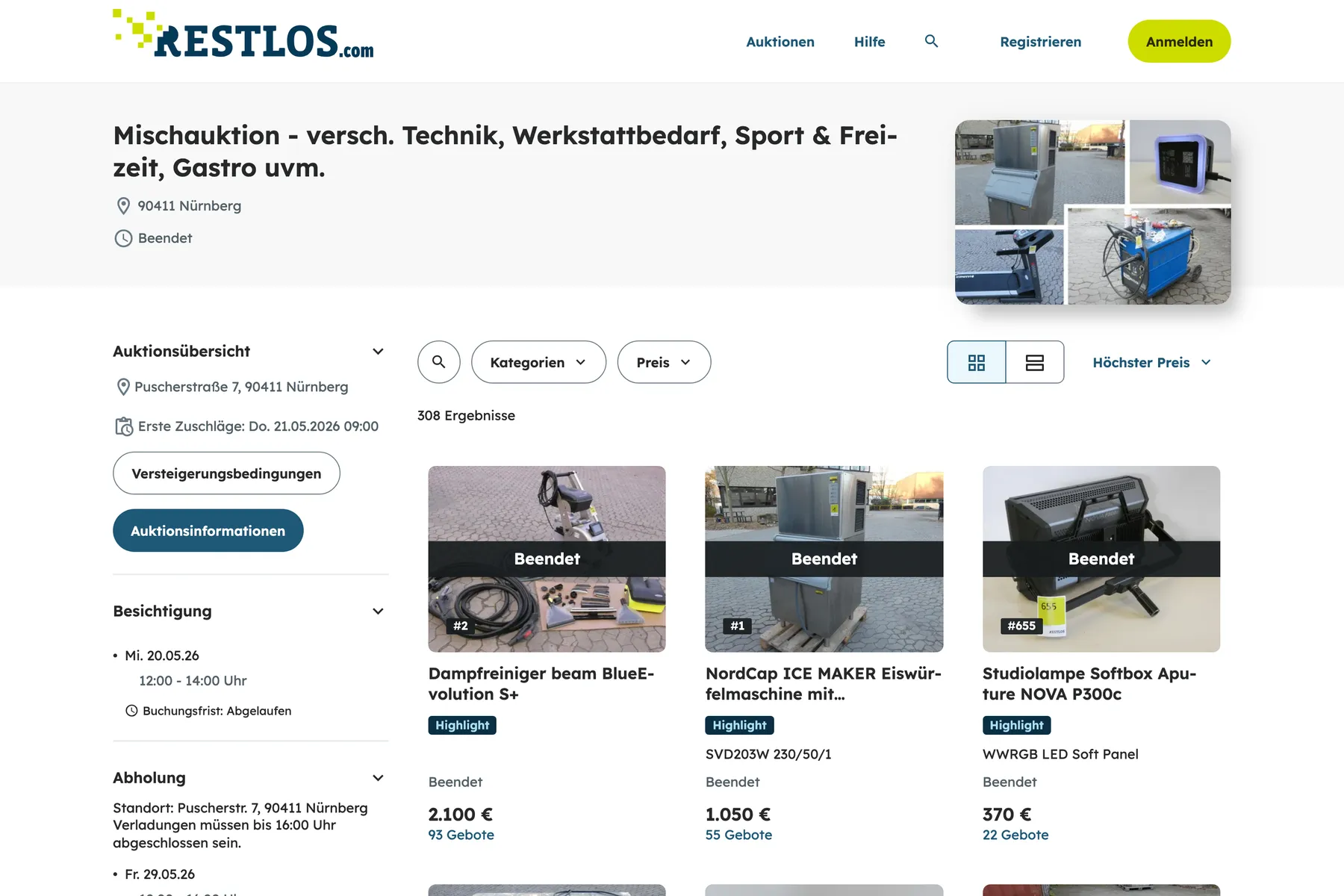
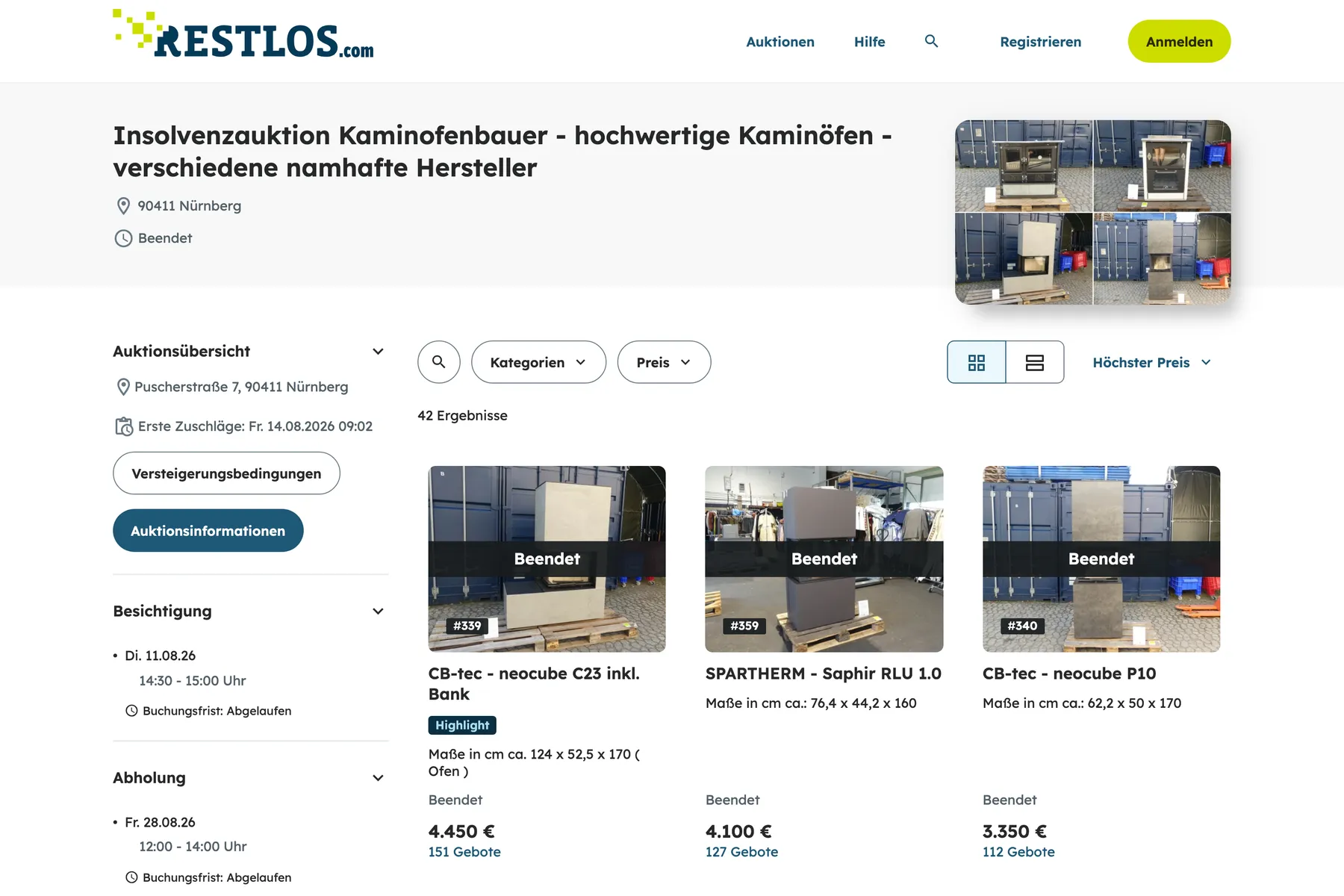
Four applications, one system: the auction storefront for bidders, the console for the office, the mobile app for the warehouse and automatic invoicing for accounting. More than 500 auctions ran through this platform in 2025, and more than a third of all bids come in through automatic maximum bids. In 2024 and 2025 it handled more than 50,000 items from an international sporting event, among much else.
The platform is public. See it running for yourself.
Why this has run reliably since 2021
A platform where money changes hands cannot afford surprises. That is why quality assurance is automated and layered.
- 11,000+
- automated tests
- 21m
- realtime messages in twelve months
- 300+
- backward-compatible migrations
- 650+
- releases since the project began
-
Tests at every level
Unit tests for the business logic, containerised API integration tests, dedicated UI test suites for each application, end-to-end tests across the whole platform, and load tests for bidding peaks. More than 11,000 automated tests in over 800 test files.
-
Built for bidding peaks
More than 21 million realtime messages pass through the platform within twelve months, so that every bid reaches everyone involved immediately. This load was exactly the sore point of the old system, which is why load tests made sure before go-live that the new platform carries it.
-
AI with an audit trail
The AI checks run versioned and with cost control, every result is documented so it can be traced, and no AI verdict replaces sign-off by a human being. That is what makes AI usable in a company that has to trust its numbers.
-
Connected third-party systems are tested too
A dedicated mock server exists for the invoicing platform, so the integration can be verified automatically without putting load on the real system.
-
Every change goes through review
Several thousand pull requests since the project began, each one checked by a second developer before it reaches the platform.
-
Orderly database evolution
More than 300 backward-compatible migrations. The data has grown continuously since 2021, without breaks.
-
Fast, small releases
The CI pipeline builds and tests only what has changed. That keeps more than 650 releases since the project began affordable, and every delivery small enough to be taken back safely.
Operated in the AWS cloud. The platform is also prepared for AI assistants to work with it in a controlled, role-based way.
The client’s view
We've been working with an expert team from qupaya technologies GmbH on our auction platform for more than four years. Based on our functional requirements and business processes, they built the platform from the ground up and keep developing it further. qupaya acts less like a typical service provider and more like an experienced partner working with us as equals. The result is a solution that fits our processes perfectly and scales with our needs. Whenever new requirements come up, we can always count on their reliable, agile execution.
How we work together
A company’s well-rehearsed process is its advantage, not its problem. Standard software would have made Restlos work like everyone else. We did it the other way round: we went through the processes together with the people who carry them out every day, from the invoicing evening to the handover at the loading ramp, and built exactly those processes into software. The rules that used to live in heads, folders and lists are in the system today: who may do what, in which order, after which payment. That makes them dependable, even when the person who always knew is on holiday.
qupaya takes responsibility for the software as a result: architecture, development, quality assurance and ongoing development, from the first requirement to the release. Behind it stands a small, stable team, the same developers over the years, who by now know the business as well as the code. The cloud infrastructure came from our partner network, parts of the design from a designer the client brought in. Everyone involved worked together throughout. Operating the platform sits with the client, in close coordination with us. Code, infrastructure and data belong to the client. And what we publish about clients is decided by the clients.
New requirements come out of the client’s day-to-day business and are prioritised and delivered continuously, without interruption since 2021. That is exactly why this page does not tell a finished project story but an ongoing one.
In our own development we use AI tools as well, deliberately and under review: every AI-generated work product goes through review by experienced developers.
How we approach projects like this one is described under From Planning to Delivery. How we pass this way of working with AI on to development teams is described in the Guided Program.
We built the complete operation of a company into software. Your business is a different one. Not a harder one.
Let’s start small
Bring the process that costs you the most time, and the people who run it. We will tell you honestly what it needs, and whether software of your own is even the right way to get there.
| S | M | T | W | T | F | S |
|---|
What happens after you book
-
Your slot is set
The calendar invite lands in your inbox right away. That is your confirmation.
-
Video link included
The link to the call is in the invite. Nothing to install.
-
Nothing to prepare
We only get in touch beforehand if we need something from you.